Showing posts with label OIC. Show all posts

Sunday, 6 December 2009

Sumatran School Visit

During my time in Sumatra I also had the opportunity to go along to a school visit. SOS supports OIC so they can visit local schools, show presentations and films, have Q&A sessions, hand out activity books and even maintain a OranguVan –which contains mobile environmental libraries and film units. The school we visited is situated in the midst of a massive oil plantation area. Most of the children attending this government run school have parents who work on the plantations, making them the perfect target group for addressing local sustainable issues such as Palm Tree plantations and de-forestation. The group we met are called the Green Group, they meet every Wednesday to discuss environmental issues, recycle and do gardening work in their school garden. They run their own pioneering composting programme where they are turning palm oil branches into compost. These branches fall off the trees at regular intervals, and are usually left to rot or collected and incinerated. The children are collecting the branches with support from the plantation and creating good quality compost which they can use at their schools patch of land or take it home to their kitchen gardens. One idea we thought about when we were at the school, was if it is possible to extend this programme to other schools in the area and create our own compost to use on re-forestation sites. I’ll let you know if anything ever comes from this initial thought.
In our presentation we discussed the importance of water, especially clean water, for the ecology and how this affects both animals and humans. We then had a Q&A session where we got to test their environmental knowledge, and they got the chance to ask us about environmental issues and of course about our countries – after all, it’s not every day they have a visit from two English people, a Norwegian and an Australian. We also had the chance to hand out a new children’s book which SOS has helped fund; Teman Hutan, which was very popular with the young conservationists.

The book is printed in English and Bahasa Indonesia, and tells the story of Pongo, the orangutan. It is a great way of explaining to children why the rainforest is so important for the orangutans and the other wildlife who depend on the Sumatran forest. Check out Captain Freddie’s website for more information.
Catch you later,
Ida


Read more...

Wednesday, 2 December 2009

Replanting rainforest

After visiting the orangutans in Bukit Lawang we headed north to visit a replanting site in Besitang, North Sumatra. The area we went to used to be a massive illegal palm oil plantation and is actually located inside the national park; the main problem with the Palm oil here in Sumatra (simply put) is that so much rainforest is being cleared to make room for the plantations that is has a direct impact on wildlife and forest biodiversity. When palm trees plantations are created, little, if any wildlife can function in these new surroundings. The orangutans cannot swing from the branches of the palms and there are no fruit trees around to support their diet.


Oh, and did I mention that OIC is the first and only NGO allowed to conduct restoration work within the park? We have been, and are still in the process of removing Palm Oil trees, thus allowing us to plant indigenous species in their place. A local farmers group is the main force involved in the reforestation process and there are currently 25,000 seedlings in the surrounding nurseries, just waiting to become a part of the rainforest. To cut a long story short, our initial reforesting target is to replant 500 hectares of orangutan habitat lost to development such as plantations. We are doing this by working with the local community group and the local farmers. Not only is this project immensely important for the upkeep of the orangutans and wildlife, but it also provides the all important sustainable livelihoods for the local community. There is a real science to re-foresting areas such as these, and advice on what plants to grow, how to grow them and how to sustain them, is coming in from experts both within Sumatra and from external scientists. We are planting approximately 70% fast growing hardwood trees and the remaining are fruit trees which will serve as good orangutan grub.

In the old plantations of Besitang, we all got down and dirty in the mud and planted some yummy looking Durian trees alongside the workers, the land owner and forest rangers. This was the first time I had the opportunity to plant rainforest myself and I must say it felt good – you should definitively try it some time!

Or, if you don’t have the chance to visit a rainforest anytime soon, you can help by buying seedlings through our online shop, at £1 a pop, it really is a great way of helping us do more crucial reforestation work.

Au revoir


Read more...

Wednesday, 25 November 2009

Visiting the orangutans

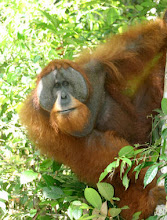
One of the main SOS projects in Sumatra is an ecotourism programme in Bukit Lawang, site of the old Orangutan rehabilitation centre inside the Gunung Leuser National Park. Bukit Lawang is a small village about three hours away from the hustle and bustle of Medan city and our office. You can’t really go to Sumatra and not go trekking to see the jungle and hopefully some of the amazing wildlife. A group from SOS and OIC was already heading there so I jumped in the OranguVan and we headed due west.

Taking all the traffic chaos of Sumatra into account, we made it to Bukit Lawang before lunch, and made our initial stop at a building which SOS has just recently purchased. Once the renovations are completed this space will be used as an internet cafe/information centre and will be staffed by OIC. This will be a place where both tourists and locals can come to learn about the rainforest and the orangutans and will have loads of information about what we do as a charity.
Bukit Lawang used to house an orangutan rehabilitation project, and still gives visitors the chance to spot orangutans and other wildlife by trekking into the jungle. You hire a guide from the Bukit Lawang guide association and head into the wild. For various reasons (disease transmitting, increased dependence on humans etc.) it is strictly forbidden to feed, touch or disturb the orangutans in any way, and the rule is that one should always keep at a safe 10 meters distance of the animals (guidelines). Unfortunately, this is not always the
case. The guides want to make money, and the tourists want their “real wildlife experience” and possibly a photo of themselves hugging the orangutan – a practise which the OIC are working to put a stop to. As we make our way through the jungle we spot an orangutan and her baby that have obviously just been fed by a tour group, we stick around for a while to ensure there is no more feeding and that no one is tempted to get a photo of themselves hugging either mother or child. In order to control these situations and hopefully put an end this practice, SOS are working with the guide association, providing an extensive training programme for guides in the area. We are also trying to generate more awareness with the tourists to encourage them to say “no thanks” if they are offered such close encounters with the animals.

During our trek we also visited a hectare of land that belongs to OIC. The
land was previously part of a rubber plantation, placed just on the outskirts of the national park. SOS were able to buy the plot with the support of Patron Bill Bailey, a couple of months ago and is working to turn this area into rainforest once again. Fast growing indigenous tree seedlings have already been planted and hopefully it will not take too long time until the area is once again covered by the rainforest. Cheers Bill!

That’s it for now, catch you later!
Ida


Read more...

Search This Blog