Showing posts with label palm oil. Show all posts

Thursday, 3 June 2010

Orangutan Sculpture


Jason Hanaman is an American sculptor specialising in orangutans. He has created a sculpture of Abdul, an orangutan Lucy helped rehabilitate many years ago and 25% of money raised through sales is donated to SOS.

The story of Abdul
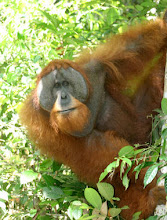
Abdul died in April 2008 after being shot by a local farmer. He was killed because he was raiding crops. This is further evidence that human-orangutan conflict is on the increase as the forest shrinks. Abdul was 19 years old when he died; a wild orangutan’s natural life span is around 50 years. He arrived at the Bohorok centre as a 4-year-old in 1993, when it was an active rehabilitation centre. SOS founding director, Lucy Wisdom, was actively involved with Abdul’s rehabilitation process. He was fully released into the wild in 1998, but found his way back to the Bohorok centre 7 months later. Looking healthy and mature, he was now sporting a beard. He was again released in 1999 but a few months later turned up at the centre. Lucy says, “In some ways it was reassuring to see him back, looking so well and knowing he had survived the past few months independently in the wild”. Most of his first four years were spent in a cage.


Abdul back in Bukit Lawang relaxing on the grass when he was still alive
Abdul was a good teacher for younger orangutans on the rehabilitation programme. Lucy said “I remember Abdul getting a pointy stick and working it into a hole in a tree. When he withdrew the stick it was covered in wild honey, which he promptly licked off, then repeated the process. Several younger orangutans watched him intently and copied his technique. I had no idea there was honey in this tree; it was in an area I often visited with my young charges as the lianas were good for climbing practice. After that I used it to teach orangutans about wild honey extraction.”

The Sculpture
Two versions are available
One is cast stone with a bronze coating and patina. Limited to 150 castings, price: $100
The other is an eco cold cast bronze made with environmentally friendly aqua resin and bronze powder. Limited to 100 castings, price: $150.
Size: 7 inches tall, 6 inches wide.

The Abdul sculpture

25% of money from sales of the sculpture will go to SOS (and 25% to Orangutan Republik)
Domestic shipping within the US: $12
International shipping: $30

To order your sculpture please e-mail: jssculpture@hotmail.com

Enjoy! XX

Read more...

Monday, 24 May 2010

Elephant day out

Saturday was the big "Meet the Artists and Conservationists" day in London. We packed our bag full of business cards and headed to town. Luckily for us it was a lovely day, probably one of the hottest days this year, so Londoners and tourists alike headed to the parks for a nice picnic and day out. The turn-out was really great, we must have talked to well over 100 people, telling them about our photo competition, about what we do, about the plight of the orangutan and life in general. Hoping more people will start sending us their photos now so that we get a nice selection before the competition closes on the 30th june. 

Everybody loves Harapan

Even the Mounted Branch of the London police force


Read more...

Tuesday, 6 April 2010

Painting Harapan, the elephant.


Hi, I'm Rebecca Sutherland, and I have designed and painted Harapan for The Elephant Parade.

I usually design things that can be scanned, photo-shopped and attached to emails. And although a life-sized baby elephant was never going to fit on my scanner, it was probably one good reason to say yes to this project. It was going to be BIG, three dimensional and extremely unusual. How hard could it possibly be? Paint elephant - job done.

Throwing myself into the project I worked out the design and ordered lots of paint and brushes, then waited. I wanted the design to reflect the endangered elephants and orangutans along with the habitat that links them. As the ele/tree trunk pun was arrived at, the rest followed easily. SOS were originally allocated a sitting elephant, however after measuring both front door and side gate, it was clear it wasn't going to fit. The Elephant Family took pity and found us the slimmer standing variety - which was great. The next problem was where to put it.

When the elephant arrived I was excited. There he was, clean and white, just like the weather outside. We stood him in the centre of our unheated glass box conservatory, and I soon found out that to work out there was akin to working in the garden. A blow heater blasted air at me as I made the first brush strokes. Half an hour later I was driven back by the cold. So behind glass doors the first badly rendered vines caught my eye as winter stubbornly kept its grip on February. Never mind, I had plenty of time.

On into March, and I acclimatised to conditions. And as the weather warmed I'd like to say I painted away oblivious to everything, mixing away on my plates then standing back to admire my progress. But daylight hours were still short and I had a full workload of other projects on. The only solution was to get up early and work late into the night. Progress was made slower by my complete ignorance of painting with acrylics, so I discussed my feeble efforts at length with my arty friends. Ultimately it was time and practice that taught me.

Four weeks later and I was only halfway up the legs, and with one week to go it didn't take a genius to figure out I wasn't going to make it. Yet my old friend fear drove me on. Then as my deadline was extended I breathed a sigh of relief, just before more work that needed my undivided attention fell on to my lap. An illustrator never turns work away, and I was determined to get it all done.

Legs, trunk, back, tail, eyes and orangutan were all eventually underway, but it wasn't until I began the background that I actually began to relax and enjoy what I was doing. I'm like this on every piece of work, not sure of what I'm doing and willing to let the autopilot of experience get on with it. Art and design looks easy, but can be as hard as writing an essay or doing a maths equation. And when that step back moment comes and I take it all in, I know if my work is good or, well, not so good.

Thankfully Harapan was good - I liked him.

Before I started this project I remember telling Helen Buckland I wanted the SOS elephant to stand out like a jewel. Well he certainly became a bit of a local attraction here, with even my window cleaners loving him. One said he reminded him of Goa where he'd seen their festival of colour. That's what I was wanted to achieve; a festival of colour.

Finally, Harapan is Sumatran for hope, a wholly appropriate description of what SOS represents. For all the difficulties encountered Harapan was certainly worth it. Because the reward is riding on the front of him, as the eye-catching and fabulous orangutan we all hope to save.


Read more...

Tuesday, 16 March 2010

Pedal Power Cinema

Hi, My name is Suzanne Turnock and for the past two months I have been funded by The Vodafone Foundation to work with SOS. I entered a competition called ‘Vodafone- World of Difference’, the prize was to work with a charity of your choice for two months and all wages are paid by Vodafone. I jumped at the chance and I knew straight away who I wanted to work with. I have been the Volunteer Fundraising Officer for The Great Apes Film Initiative (GAFI) since June 2009, SOS is one of GAFI’s partners and have worked together for the past 5 years.
I saw this opportunity as I chance to organise the SOS and GAFI Pedal Power Cinema project in Sumatra. So for the past two months I have been organising and fundraising for the project, based at the SOS UK headquarters in Oxford. One of my main goals was to organise a Pedal Power Cinema event in Oxford, to raise funds and to raise awareness about SOS and GAFI’s work. This event took place on the 10th March at Oxford Brookes University. Using Pedal Power Cinema, we screened Patrick Rouxel’s ‘Losing Tomorrow’, a poetical film on the habitat of orangutans and an insight into the logging industry in Indonesia and ‘Dear Mr President’, a short film created at the request of local communities in Sumatra. World renowned Conservationist, Ian Redmond OBE was our special guest speaker for the evening and David Smith, Olympic Athlete on the GB Rowing Team, started the pedalling for us. We also had a raffle, refreshments and merchandise for sale. From the feedback we have received so far, it seems like this was a really successful event and guests were interested and excited about using Pedal Power Cinema for conservation education.

During my time with SOS, I have been writing grant applications, liaising with the team in the field to organise the project and helping Helen out with the day to day running of SOS when needed. I also helped out with the SOS collection day in February at Victoria Station in London.

This project has the potential to expand on SOS’ conservation education programmes in Sumatra. The Pedal Power Cinema can be taken to remote communities, which often lack electricity and show wildlife films to local people, who may have never seen an orangutan or are not aware of the need to protect the critically endangered species. Film screenings attract large crowds, therefore providing a unique opportunity to deliver powerful and effective conservation messages as well as providing a platform for people to raise their conservation concerns. Once we have received the required funding for this project, it can begin.

I finished my two month placement with SOS on 12th March. I am really proud of what I have achieved in a small amount of time and I have enjoyed every minute of working with the SOS team. I chose SOS as I believed they are an organisation that works tirelessly, with passion and determination, to save the Sumatran orangutan and their habitat from extinction- and they proved me right.

Read more...

Sunday, 6 December 2009

Sumatran School Visit

During my time in Sumatra I also had the opportunity to go along to a school visit. SOS supports OIC so they can visit local schools, show presentations and films, have Q&A sessions, hand out activity books and even maintain a OranguVan –which contains mobile environmental libraries and film units. The school we visited is situated in the midst of a massive oil plantation area. Most of the children attending this government run school have parents who work on the plantations, making them the perfect target group for addressing local sustainable issues such as Palm Tree plantations and de-forestation. The group we met are called the Green Group, they meet every Wednesday to discuss environmental issues, recycle and do gardening work in their school garden. They run their own pioneering composting programme where they are turning palm oil branches into compost. These branches fall off the trees at regular intervals, and are usually left to rot or collected and incinerated. The children are collecting the branches with support from the plantation and creating good quality compost which they can use at their schools patch of land or take it home to their kitchen gardens. One idea we thought about when we were at the school, was if it is possible to extend this programme to other schools in the area and create our own compost to use on re-forestation sites. I’ll let you know if anything ever comes from this initial thought.
In our presentation we discussed the importance of water, especially clean water, for the ecology and how this affects both animals and humans. We then had a Q&A session where we got to test their environmental knowledge, and they got the chance to ask us about environmental issues and of course about our countries – after all, it’s not every day they have a visit from two English people, a Norwegian and an Australian. We also had the chance to hand out a new children’s book which SOS has helped fund; Teman Hutan, which was very popular with the young conservationists.

The book is printed in English and Bahasa Indonesia, and tells the story of Pongo, the orangutan. It is a great way of explaining to children why the rainforest is so important for the orangutans and the other wildlife who depend on the Sumatran forest. Check out Captain Freddie’s website for more information.
Catch you later,
Ida


Read more...

Wednesday, 2 December 2009

Replanting rainforest

After visiting the orangutans in Bukit Lawang we headed north to visit a replanting site in Besitang, North Sumatra. The area we went to used to be a massive illegal palm oil plantation and is actually located inside the national park; the main problem with the Palm oil here in Sumatra (simply put) is that so much rainforest is being cleared to make room for the plantations that is has a direct impact on wildlife and forest biodiversity. When palm trees plantations are created, little, if any wildlife can function in these new surroundings. The orangutans cannot swing from the branches of the palms and there are no fruit trees around to support their diet.


Oh, and did I mention that OIC is the first and only NGO allowed to conduct restoration work within the park? We have been, and are still in the process of removing Palm Oil trees, thus allowing us to plant indigenous species in their place. A local farmers group is the main force involved in the reforestation process and there are currently 25,000 seedlings in the surrounding nurseries, just waiting to become a part of the rainforest. To cut a long story short, our initial reforesting target is to replant 500 hectares of orangutan habitat lost to development such as plantations. We are doing this by working with the local community group and the local farmers. Not only is this project immensely important for the upkeep of the orangutans and wildlife, but it also provides the all important sustainable livelihoods for the local community. There is a real science to re-foresting areas such as these, and advice on what plants to grow, how to grow them and how to sustain them, is coming in from experts both within Sumatra and from external scientists. We are planting approximately 70% fast growing hardwood trees and the remaining are fruit trees which will serve as good orangutan grub.

In the old plantations of Besitang, we all got down and dirty in the mud and planted some yummy looking Durian trees alongside the workers, the land owner and forest rangers. This was the first time I had the opportunity to plant rainforest myself and I must say it felt good – you should definitively try it some time!

Or, if you don’t have the chance to visit a rainforest anytime soon, you can help by buying seedlings through our online shop, at £1 a pop, it really is a great way of helping us do more crucial reforestation work.

Au revoir


Read more...

Wednesday, 25 November 2009

Visiting the orangutans

One of the main SOS projects in Sumatra is an ecotourism programme in Bukit Lawang, site of the old Orangutan rehabilitation centre inside the Gunung Leuser National Park. Bukit Lawang is a small village about three hours away from the hustle and bustle of Medan city and our office. You can’t really go to Sumatra and not go trekking to see the jungle and hopefully some of the amazing wildlife. A group from SOS and OIC was already heading there so I jumped in the OranguVan and we headed due west.

Taking all the traffic chaos of Sumatra into account, we made it to Bukit Lawang before lunch, and made our initial stop at a building which SOS has just recently purchased. Once the renovations are completed this space will be used as an internet cafe/information centre and will be staffed by OIC. This will be a place where both tourists and locals can come to learn about the rainforest and the orangutans and will have loads of information about what we do as a charity.
Bukit Lawang used to house an orangutan rehabilitation project, and still gives visitors the chance to spot orangutans and other wildlife by trekking into the jungle. You hire a guide from the Bukit Lawang guide association and head into the wild. For various reasons (disease transmitting, increased dependence on humans etc.) it is strictly forbidden to feed, touch or disturb the orangutans in any way, and the rule is that one should always keep at a safe 10 meters distance of the animals (guidelines). Unfortunately, this is not always the
case. The guides want to make money, and the tourists want their “real wildlife experience” and possibly a photo of themselves hugging the orangutan – a practise which the OIC are working to put a stop to. As we make our way through the jungle we spot an orangutan and her baby that have obviously just been fed by a tour group, we stick around for a while to ensure there is no more feeding and that no one is tempted to get a photo of themselves hugging either mother or child. In order to control these situations and hopefully put an end this practice, SOS are working with the guide association, providing an extensive training programme for guides in the area. We are also trying to generate more awareness with the tourists to encourage them to say “no thanks” if they are offered such close encounters with the animals.

During our trek we also visited a hectare of land that belongs to OIC. The
land was previously part of a rubber plantation, placed just on the outskirts of the national park. SOS were able to buy the plot with the support of Patron Bill Bailey, a couple of months ago and is working to turn this area into rainforest once again. Fast growing indigenous tree seedlings have already been planted and hopefully it will not take too long time until the area is once again covered by the rainforest. Cheers Bill!

That’s it for now, catch you later!
Ida


Read more...

Monday, 23 November 2009

Ida Bondø – PR Volunteer, Ubud, Bali

Hi, and welcome to our newly created blog.
Through this blog we hope to spread the word about the Sumatran orangutans, the work we do in the Sumatran rainforest and how you can help us save a species.

About me- My name is Ida and I am going to be working with the Sumatran Orangutan Society for the next few months. I will be based in their Bali office in Ubud, which I am really looking forward to. With me I have my partner William Lee-Wright, who is also dedicating his time in Bali
to working with SOS.

Luckily for me, I arrived in Indonesia around the same time as Helen Buckland, the UK Director, made her annual trip out here. Which meant that I had the opportunity to go to Sumatra and visit some of the projects in the field before heading towards Bali.

Arriving in Medan was quite a culture shock. I came across from Malaysia on a small ferry, and stepping out of the boat it was immediately clear that the skyscrapers and Gucci filled shopping centres of Malaysia were several sea miles behind me. The roads, lack of roads and the rally-driving turned out to be a bit much even for the most hardened traveller, but eventually we made it to the hotel. Our room incidentally turned out to have the best view of the Medan’s main mosque, and we were woken up before the crack of dawn the following morning.

In Medan, SOS shares their offices with the Orangutan Information Centre, OIC, which is a local NGO doing much of the fieldwork here. So on Monday, holding on for our dear lives, we ventured into a ‘becac’ (a moped with a small chair-box on the left hand side) and headed towards the ex-pat community in Medan. Finally, one year and half a world since I first made contact with SOS, I got to meet Helen. We had a great introductory session where we talked about how I can best utilise my time in Bali to ensure I can provide maximum support to SOS throughout my stay. I also had the chance to meet the team working in Medan, including Dave the whistling Scientific Director, Panut the knowledgeable OIC Director and Aiba the energetic AUSAid Volunteer. I left the office with hands full of reading material and a brain full of new ideas to process.

My main projects will be PR related and I will introduce you to some of them as the weeks go by. Though, next week I will first have to tell you about our trip to Bukit Lawang, and my first encounter with some of the beautiful orangutans that live in the national forest.
Till then, take care...
Ida


Read more...

Search This Blog